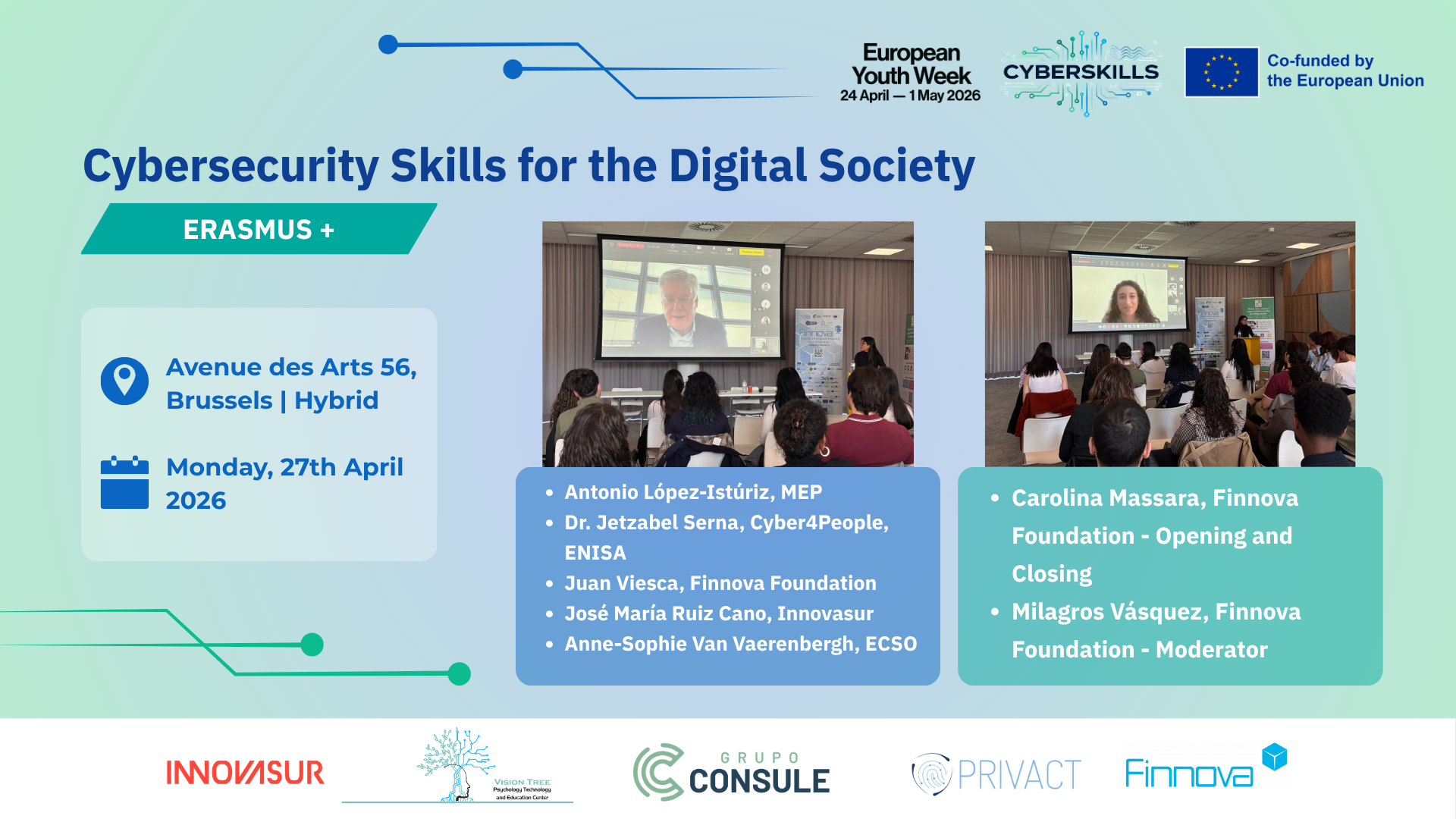
• Member of the European Parliament Antonio López-Istúriz delivered a keynote speech on “New skills for a new world”.
European Youth Week 2026 set the stage for a timely conversation. On Monday 27 April, Brussels brought together policymakers, cybersecurity professionals and young Europeans to explore how the Erasmus+-funded CyberSkills initiative is turning one of Europe's most pressing challenges into an opportunity for the next generation.
The policy dimension came from Antonio López-Istúriz, Member of the European Parliament, who addressed the room with a clear message for young Europeans: adaptability and critical thinking are the competencies that will define this era. Drawing a parallel with the industrial revolution, he warned against becoming prisoners of unchecked technological change."These technologies are positive developments, but they must be regulated”.
Europe's cybersecurity deficit took centre stage with José María Ruiz Cano, Learning and Developmente of Innovasur, and project leader of CyberSkills, who set the scene with stark figures: over 10,000 cyberattacks in Europe in 2024, a defence deficit, and human error as a persistent vulnerability. His answer was CyberSkills, a project built on training and cross-border cooperation, offering participants a recognised cybersecurity training as a concrete step toward professional readiness.
The talent ecosystem was the focus of Anne-Sophie Van Vaerenbergh, Skills & Human Factors Manager at ECSO (European Cyber Security Orgazation), who introduced Road2Cyber, a free talent pool connecting cybersecurity students and professionals through webinars and career development sessions. Her message went beyond the platform: "This is not only an initiative, it is what we need to collaborate and build more cybersecurity capacity in Europe." She noted that the gap between academia and industry is real but fixable, and that soft skills matter as much as technical ones.
From an industry standpoint, Dr. Jetzabel Serna, CEO and Founder at Cyber4People and appointed member of ENISA's European Cybersecurity Skills Framework Working Group,argued the challenge is not only about talent but about distribution: "Cybersecurity must be approached as a shared responsibility across organisations, not something that relies solely on dedicated experts." Her call was for a people-centred culture where every employee, not just specialists, has a role in digital defence.
The session was moderated by Milagros Vásquez, Communication Trainee at Finnova.Carolina Massara, EU Project Manager at Finnova, opened the event by framing European Youth Week 2026 as a moment to actively reflect on how Europe can empower young people in a rapidly evolving digital and green world. She set the tone for the day, positioning CyberSkills alongside the other featured projects as part of a shared European commitment to bridging the skills gap. In her closing, she brought the same conviction full circle, encouraged the audience to keep following the progress of the projects, a reminder that the conversation started that Monday in Brussels was far from over.
CyberSkills is an Erasmus+ Key Action 220 project, a partnership for cooperation designed to develop training materials, digital tools and new certifications in education and vocational training. During the event, Juan Viesca, EU Project Manager of Finnova highlighted the remarkable reach of the programme that makes it possible: open to almost every country in the world and with over 300,000 projects funded to date. "Erasmus+ is not just mobility," he said, "it is a very big programme in education and vocational training."
For more information about the CyberSkills project and upcoming activities, visit https://cyber-skills.eu/